The Making of Foxcroft
A seven-decade study of how a mid-century planned neighborhood in Charlotte's south became one of the Carolinas' most enduring luxury addresses.
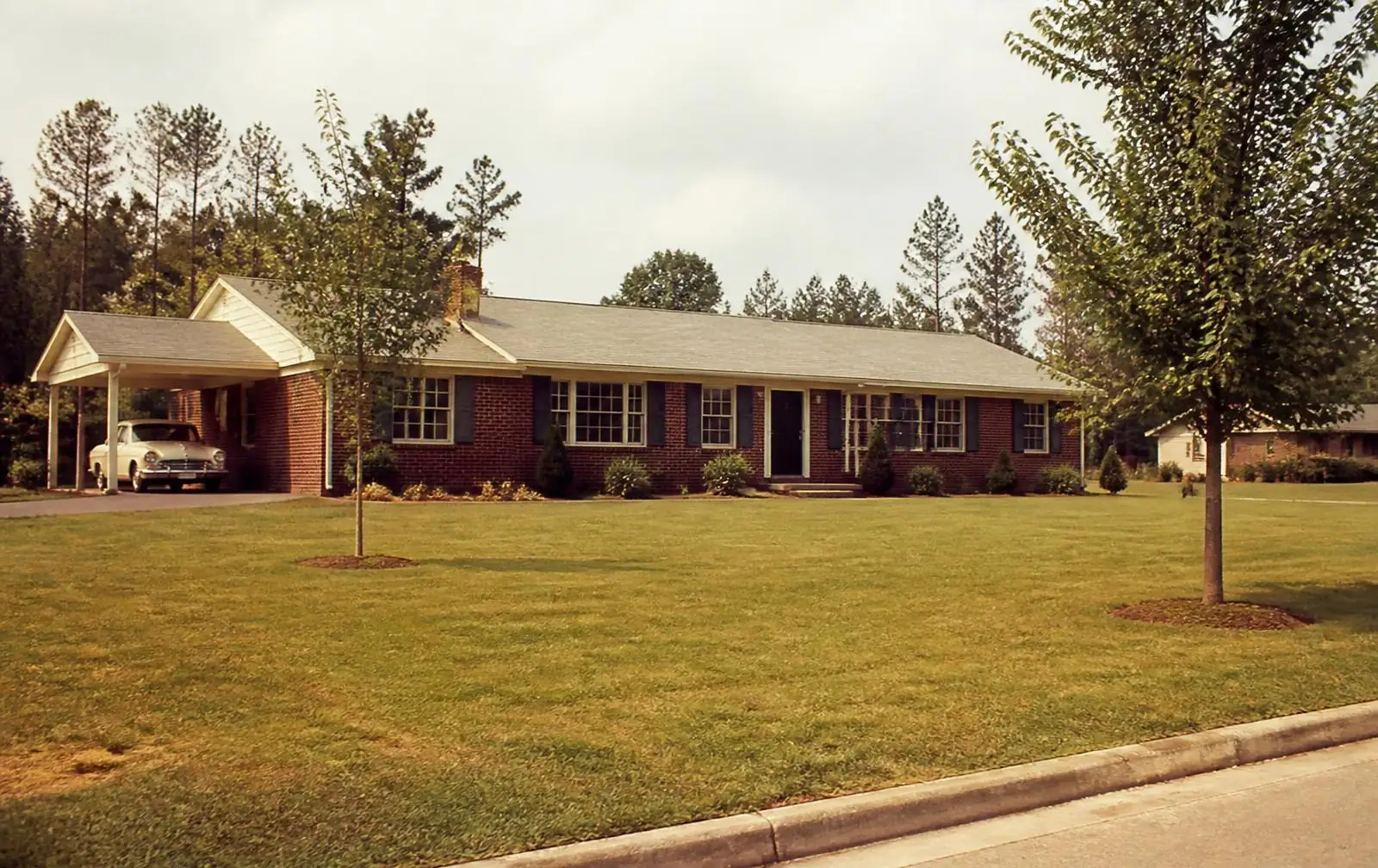
Origins in the Post-War South
Foxcroft was conceived in the years immediately following World War II, when Charlotte — then a city of roughly one hundred thousand — was beginning its first great expansion beyond the traditional streetcar suburbs of Myers Park and Eastover. Land south of Sharon Road, still largely rolling pasture and hardwood forest, offered developers something the older neighborhoods could no longer supply: acreage, at scale, close enough to town to serve as a next-chapter address for Charlotte's growing professional class.
The plan for Foxcroft prioritized what would prove to be its most durable asset — trees. Rather than clear the site and grid it, developers routed streets around the existing hardwoods and set generous minimum lot sizes to preserve the canopy that already existed. Where new trees were planted, they were long-lived species: willow oak, white oak, southern magnolia, tulip poplar.
The First Estates
Foxcroft's earliest homes, built through the 1950s and into the 1960s, reflect the era's classicism: painted brick Georgian and Federal facades, symmetrical elevations, slate and cedar-shake roofs, and the restrained proportions that had defined Southern country houses for two centuries. Many of these homes remain in place today — a number of them beautifully preserved, others thoughtfully renovated to contemporary standards without erasing their original character.
The homes were substantial from the beginning. What has changed most in Foxcroft is not the houses themselves — it is the trees around them.
Growth Alongside SouthPark
Foxcroft's trajectory shifted meaningfully in 1970, when SouthPark Mall opened on the north side of Sharon Road. Overnight, one of Charlotte's quietest luxury neighborhoods found itself next door to what would become the South's most important shopping district. Rather than diminish Foxcroft, SouthPark's ascendance amplified it: the neighborhood retained its interior seclusion while gaining a level of convenience that few luxury addresses in America can rival.
The Renovation Era
Beginning in the 1990s, and accelerating markedly through the 2000s and 2010s, Foxcroft entered what might be called its renovation era. Original owners aged out; a new generation acquired the neighborhood's estates and set about updating them for modern life. Kitchens opened up. Primary suites grew. Guest houses, pool houses, and detached garages appeared. Whole-home renovations became routine.
Crucially, this second chapter was carried out with an unusual degree of restraint. Foxcroft did not tear itself down. It refined itself. New construction that did emerge — and it has emerged, particularly on assembled lots and on properties where original homes were beyond practical restoration — was designed to respect the neighborhood's scale, setback, and vocabulary.
Foxcroft Today
Today, Foxcroft is one of Charlotte's most stable luxury neighborhoods by nearly every measure: turnover, price per square foot, absorption of new construction, and reputation among Charlotte's leading brokerages. It is also — quietly — one of the most interesting. The mix of preserved mid-century originals, meticulously renovated estates, and a slow trickle of new custom homes gives Foxcroft an architectural range that most single-generation neighborhoods simply cannot offer.
Continue to Foxcroft Architecture or read the current Foxcroft Market Report.
Frequently Asked
When was Foxcroft in Charlotte developed?+
Foxcroft was developed principally from the late 1940s through the 1960s, as Charlotte's post-war growth pushed south from Myers Park and Eastover.
How did Foxcroft get its name?+
The name reflects the English countryside naming conventions favored by mid-century Charlotte developers, in keeping with the neighborhood's traditional architecture.
What did the land look like before development?+
Largely wooded and agricultural land south of the city's established residential core, which is why so many mature hardwoods survived into the neighborhood plan.
Why is Foxcroft's tree canopy so mature?+
The original plan preserved existing hardwoods and set houses back on wide lots, and seventy-plus years of growth have produced one of Charlotte's densest residential canopies.
How has Foxcroft changed over time?+
The architecture has evolved from modest brick ranches to renovated and newly built estates, but the street plan, lot sizes, and canopy that define the neighborhood are unchanged.
Is Foxcroft a historic district?+
Foxcroft is not a designated local historic district. Its character has been preserved by market expectation, lot size, and the canopy rather than by regulation.
Experience Foxcroft in person.
For families evaluating a move to Foxcroft, Peters & Associates arranges private, unhurried tours of the neighborhood — including preserved originals, recent renovations, and off-market opportunities.
Georgian, Federal, Colonial Revival, and modern estates — a field guide to the neighborhood's styles.
The addresses long considered the most desirable within the neighborhood.
Current cycle pricing, absorption, and inventory across the Foxcroft luxury market.